
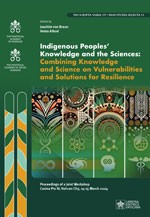
sv157pas.jpg

Indigenous Peoples’ Knowledge and the Sciences: Combining Knowledge and Science on Vulnerabilities and Solutions for Resilience

Proceedings of a Joint Workshop
14-15 March 2024
Joachim von Braun and Helen Alford (eds.)
Scripta Varia 157, LEV, Vatican City, 2025
pp. 440 | ISBN: 978-88-266-1014-6
DOI: 10.65398/OMJD7446
Contents

1: Opening Session

Introduction: Indigenous Peoples’ Knowledge and the Sciences – Combining Knowledge and Science

PAS President Joachim von Braun and PASS President Sr Helen Alford

Keynote on Indigenous Peoples’ Knowledge and the Sciences

Sonia Guajajara, Minister, Ministry of Indigenous People, Brazil

The United Nations System and Indigenous Peoples – Towards Knowledge Partnerships for Sustainable Development

Nigel Crawhall, Chief of Section, Local and Indigenous Knowledge Systems Programme, Natural Sciences Sector, UNESCO

Traditional Knowledge of Indigenous Peoples: Voices of Respect for Sacred Nature and Transdisciplinary Stewardship of Mother Earth

Octaviana V. Trujillo (Yaqui), Founding Chair and Professor of the Applied Indigenous Studies Department at Northern Arizona University in Flagstaff, Arizona; and Teresa Newberry

2: Regional insights and outlooks by Indigenous Peoples

2.1. Perspectives from Africa

Traditional Knowledge of Weather Forecasting among Maasai Pastoralists in Northern Tanzania: Navigating Climate Change and its Impacts

Elifuraha Laltaika, Tumaini University Makumira, Faculty of Law, Senior Lecturer of Human Rights Law & Policy

Indigenous Knowledge and Climate Change Adaptation Strategies: Lessons from Maasai Pastoralists of East Africa

Stanley Kimaren ole Riamit, Indigenous Livelihoods Enhancement Partners (ILEPA)

2.2. Perspectives from the Americas

Los conocimientos tradicionales de los Pueblos Indígenas en experiencias de salud y educación intercultural en Abya Yala

Myrna Cunningham Kain, Chair of Pawanka Fund and Vice President of Fund for Development of Indigenous Peoples in Latin America and the Caribbean-FILAC. Former chair of the Center for Autonomy and development of Indigenous Peoples-CADPI

Ti Szwatenem: What We Know: The Gift of Indigenous Knowledge for Life and Living and the Challenges of Exclusion

Lorna Wanosts’a7 Williams, Member First Nation, Professor Emerita, Lil’watul; University of Victoria, Canada

2.3. Perspectives from Asia

India’s Experiences on Traditional Knowledge and Traditional Knowledge Digital Library (TKDL)

Viswajanani Sattigeri, Council of Scientific and Industrial Research, Traditional Knowledge Digital Library Unit, India

Leveraging Local Knowledge, Creativity and Innovation-Based Entrepreneurial Opportunities

Anamika Dey, CEO, Gujarat Grassroots Innovation Augmentation Network [GIAN], India

3: Indigenous Peoples’ knowledge systems for health and pharmaceutical products and the sciences – innovation opportunities, rights, policies

Bridging Indigenous Knowledge and the Science: The Role of Indigenous Peoples in Health and Pharmaceutical Products Development

Ester Innocent, Institute of Traditional Medicine, Muhimbili University of Health and Allied Sciences, Dar es Salaam, Tanzania

Scientific Validation of Traditional Medicines: Perspectives of ICMR-National Institute of Traditional Medicine, Belagavi, India

Harsha Hegde & Subarna Roy, ICMR-National Institute of Traditional Medicine, Indian Council of Medical Research, Dept. of Health Research, Government of India

Beyond Sacred Ecology: Indigenous Peoples’ Observations to Advance the Understanding of Earth’s Systems

Yolanda López-Maldonado, Geography Department, Ludwig Maximilian University of Munich, Germany

Phytotherapy for the Health of All

Msgr Samuel Kleda, Archbishop of Douala, Cameroon

Promoting and Protecting Indigenous Knowledge and Contributions to Health

Pauliina Nykanen-Rettaroli, Indigenous Peoples’ Focal Point in the World Health Organisation

4: The importance of Indigenous Peoples for climate, biodiversity, food and nutrition agendas

4.1. Biodiversity and nature protection

Biodiversity and Social-Ecological Research for People and Nature

Katrin Böhning-Gaese, Director and Professor, Senckenberg Biodiversity and Climate Research Centre, Frankfurt University, Germany

Ărramăt Model – Global Indigenous-Led Research for Biodiversity Conservation and Indigenous Health and Well-being

Mariam Wallet Aboubakrine; Brenda Parlee; Danika Billie Littlechild; Sherry Pictou; John O’Neil; Murray Humphries; et al.

Sustainable Wildlife Management: Why Indigenous People Matter

Robert Nasi and Julia E. Fa, Director General, Center for International Forestry Research (CIFOR), and Department of Natural Sciences, Manchester Metropolitan University, UK

IFAD engagement with Indigenous Peoples for Climate, Biodiversity, Food and Nutrition Agendas

Ilaria Firmian, IFAD Senior Technical Specialist – Indigenous Peoples

Amazonian Forests Protected by Indigenous People

Paulo Artaxo, University of São Paulo, Director of the Center for Amazonian Sustainability, Brazil

The Role of Traditional Knowledge in the Kunming-Montreal Global Biodiversity Framework

Q"apaj Conde, Secretariat of the Convention on Biological Diversity, Associate Programme Management Officer

4.2. Food systems

New Wine into Old Wineskins: Indigenous Peoples’ Food and Knowledge Systems as Key for a Sustainable Planet

Tania Eulalia Martínez-Cruz, Universidad Intercultural Maya de Quintana Roo, Mexico; and Adelman Levi

The Future of Food is Ancestral: Mesoamerican Plant-Centred Food Traditions as Climate Solutions

Erika Xananine Calvillo Ramírez, Universidad Nacional Autónoma de México

Leveraging Indigenous Knowledge and Modern Science for Sustainable Food System Transformation

Mehrdad Ehsani, Peiman Milani, John de la Parra, Roy Steiner, The Rockefeller Foundation Food Initiative, Nairobi, Kenya

Recognizing Farmers’ Indigenous Innovations in Africa

Justice Tambo, Senior Socio-Economist CABI, Switzerland

Indigenous Knowledge in Participatory and Evolutionary Plant Breeding

Hanieh Moghani, Senior Legal Counsel and Indigenous Advocate, Centre for Sustainable Development and Environment (CENESTA), Tehran, Iran

Food System and Indigenous Knowledge and Science

Maximo Torero, Chief Economist, FAO

4.3. Climate – Adaptation, mitigation, transformation

The Role of Indigenous People Knowledge in Climate Change Mitigation and Adoption

Agnes Leina Il'laramatak, Community Concerns Executive Director

The Maasai Response to the Climate Crisis – A Global Outlook on Indigenous peoples

Nelson Ole Reiya, Nashulai Maasai Conservancy, CEO, Kenya

5: Braiding science and indigenous knowledge and education

Braiding Indigenous Knowledges and Western Science: Remembering Who We Are and Reclaiming Our Sacred Responsibility to Mother Earth

Ora Marek-Martinez, PhD, Northern Arizona University, Office of Native American Initiatives / Anthropology Department, Associate Vice President / Assistant Professor. Center for Braiding Indigenous Knowledges and Science, Co-Principal Investigator

The United States Federal Government Recognizes the Importance of Indigenous Knowledge with New Policies and Actions

Jane Lubchenco, PAS Academician; Oregon State University, Department of Integrative Biology

Climate Change Education Facing Traditional Cultures

Pierre Léna and Djian Sadadou. Office for Climate Education, Paris, France

Science Education as a Perspective for Young Minorities in General

M.E. Firmino, B.J. Muniz, A. Muniz, M. Barbosa, Y.M. Gamez, G. Bertolino and Vanderlei S. Bagnato

How Astronomers Explore the World and What They Have Learned – And Not Yet

Adriano Fontana, Research Director, INAF – Osservatorio Astronomico di Roma, Istituto Nazionale di Astrofisica

Exploring Indigenous and Contemporary Science Through Hawaiʻi Astronomy

Doug Simons. Professor, Director, Institute for Astronomy University of Hawaii at Manoa