
acta28pas.jpg

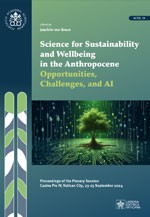
Science for Sustainability and Wellbeing in the Anthropocene: Opportunities, Challenges, and AI

Proceedings of the Plenary Session | 23-25 September 2024
J. von Braun (ed)
Acta 28 | Vatican City 2025
pp. xxx | ISBN 978-88-266-1061-0
DOI: 10.65398/MXJW4309
Contents

I: The Anthropocene – concept, measurement, human adaptation, and role of the sciences as cause and cure

Science for the Anthropocene – an introduction

Prof. Jürgen Renn, Max Planck Institute for Geoanthropology, Jena, Germany

Anthropocene stratigraphy

Prof. Francine M.G. McCarthy, Professor, Earth Sciences. Brock University, Canada, and Anthropocene Working Group, International Commission on Stratigraphy

On Human Anthropology: Human Adaptation and Evolution

Tekklu Zeresenay Alemseged (PAS), University of Chicago

Religion, the sciences and the Anthropocene

PAS Chancellor Cardinal Peter K.A. Turkson

II: Climate crisis, biodiversity loss, and human contexts – outlook and needed actions for a habitable earth

An Historic Down Payment: Integrated Action to Tackle the Interacting Triple Crises of Climate Change, Loss of Biodiversity, and Inequity/Inequality

Prof. Jane Lubchenco (PAS) Deputy Director for Climate and Environment, White House Office of Science and Technology Policy; and University Distinguished Professor and Valley Professor of Marie Biology, Oregon State University

Air Quality, Climate, and Health in the Anthropocene

Prof. Ulrich Pöschl, Director at the Max Planck Institute for Chemistry and professor at the Johannes Gutenberg University (JGU) in Mainz, Germany

Climate Change and Habitability: A Timeline

Dr. Kira Vinke, Head of the Center for Climate and Foreign Policy at the German Council on Foreign Relations (DGAP)

Climate Crisis, Biodiversity Loss and Human Contexts

Prof. V. Ramanathan (PAS), Professor Emeritus, Scripps Institution of Oceanography, University of California, San Diego, USA

Climate Crisis, Biodiversity Loss and Human Contexts

Prof. Hans-Joachim Schellnhuber (PAS), Director General IIASA, Austria

III: Artificial Intelligence for sciences, innovations and sustainability - opportunities and risks

Accelerating scientific discovery with AI

Sir Demis Hassabis (PAS), Google DeepMind, UK

AI and the Forces Changing Science in the 21st Century

Prof. Frances Hamilton Arnold (PAS), Professor of Chemical Engineering, Bioengineering and Biochemistry at the California Institute of Technology (Caltech), External co-chair of President Joe Biden’s Council of Advisors on Science and Technology

Borges and AI

Léon Bottou and Bernhard Schölkopf, FAIR, Meta, New York, USA and Max Planck Institute for Intelligent Systems and ELLIS Institute Tübingen, Germany, respectively

Sustainability and Wellbeing in the Context of AI: A Paradox

Prof. Virginia Dignum, Professor of Responsible Artificial Intelligence at Umeå University (Dept of Computing Science) and director of the AI Policy Lab. Member of United Nations High Level Advisory Body in AI

Materials for the quantum age

Prof. Cristiane Morais Smith, Chair Condensed-Matter Physics, Utrecht University, ITP

Fundamental Considerations Inspired by Quantum Physics

Prof. Anton Zeilinger, University of Vienna, Institute for Quantum Optics and Quantum Information, Austria

Global Environmental Measurement and Monitoring (GEMM)

Prof. Donna Strickland (PAS), Professor, University of Waterloo, Canada

Exploring the Quantum World through Quantum Simulations

Prof. Immanuel Bloch, Scientific Director, Max Planck Institute of Quantum Optics, Germany

Quantum Simulation and New Quantum Phases with Long-Range-Interacting Ultra-Cold Atoms

Prof. Francesca Ferlaino, Institute Scientific Director, University of Innsbruck, and Austrian Academy of Sciences, IQOQI, Austria

Quantum Systems Open to the World

Prof. Ana Asenjo-Garcia, Associate Professor of Physics, Columbia University, USA

IV – Live sciences innovations, health and medical sciences

The Influence of Carbon Dioxide Levels in Peroxide Metabolism in Mammalian Cells

Prof. Rafael Radi (PAS), Professor Departamento de Bioquímica, Facultad de Medicina and Director of Centro de Investigaciones Biomédicas (CEINBIO), Universidad de la República, Montevideo, Uruguay

Design and Evolution of New Metabolism for Greenhouse Gas Assimilation

Prof. James C. Liao, President of Academia Sinica, Taiwan, Professor and Chair of the Department of Chemical and Biomolecular Engineering at the University of California, Los Angeles

A Solution to Antimicrobial Resistance: Antimicrobial Photodynamic Therapy

Prof. Tebello Nyokong (PAS), Distinguished Professor of Chemistry and the Director of Institute for Nanotechnology Innovation at Rhodes University, South Africa

Biological Clocks, Thermotolerance, and Fitness: Seeing Through the Eyes of a Fungus

Prof. Luis F. Larrondo Castro, Full Professor, Biological Sciences, Pontificia Universidad Católica de Chile, Chile

The Future of Genomic Medicine

Prof. Eric Lander (PAS), Broad Institute, MIT, and Harvard, USA

Marine Science with AI for Sustainability and Wellbeing. Geomic Big Bang

Prof. Takashi Gojobori (PAS), Distinguished Professor King Abdullah University of Science and Technology

AI Research and Infrastructure for the Life Sciences: The EMBL Perspective

Dr. Rolf Apweiler, Joint Director of European Molecular Biology Laboratory (EMBL), European Bioinformatics Institute (EBI), UK

V –Astronomy and changing world views

Advancing Sustainability with Space Technology

Prof. Maria T. Zuber, Presidential Advisor for Science and Technology Policy and E. A. Griswold Professor of Geophysics at MIT; Co-chair of President Biden’s Council of Advisors on Science and Technology

Changing Astronomy and AI: The Case of Rubin Observatory and its Legacy Survey of Space and Time

Prof. Zeljko Ivezic, Professor of Astronomy University of Washington, Director of the Vera C. Rubin Observatory Construction Project

New Advances in Exoplanet Science with JWST

Prof. Nikku Madhusudhan, Professor of Astrophysics and Exoplanetary Science, University of Cambridge, UK

Astronomy and Changing World Views

Prof. Ewine van Dishoeck (PAS), Leiden University, The Netherlands

Life in the Universe: Astrophysics Perspectives

Prof. Didier Queloz (PAS), Professor ETH Zurich, Switzerland

VI – Sciences and AI linking with traditional & indigenous knowledge for addressing Anthropocene issues

Artificial Intelligence, Traditional Ecological Knowledge and Indigenous Peoples

Prof. Octaviana Trujillo, Chair and Professor Emerita in the Department of Applied Indigenous Studies at Northern Arizona University

Coupling Technology with Traditional Knowledge for Health and Wellbeing: Harnessing AI

Dr. Subarna Roy, Director, ICMR National Institute of Traditional Medicine, Belagavi, India

Balancing food security, the environmental impact of crops, and equitable use of new technology

Sir David Baulcombe (PAS), Regius Professor of Botany Emeritus, Cambridge University, UK

VII - Science-Policy perspectives – a high level panel session with brief introductory statements by panellists related to aspects of the themes of Anthropocene and AI

The Science-Policy Interface: Closing Knowledge Generation Gaps between the Global North and the Global South for Sustainable Development

Prof. Quarraisha Abdool Karim, President of The World Academy of Sciences for the advancement of science in developing countries (UNESCO-TWAS), South Africa

Making Anthropocene Sustainable

Prof. Carlos Gilberto Carlotti Jr, Rector of Universidade de São Paulo, Brazil and Professor Faculty of Medicine, Neurosurgery

Statement on Science-Policy Perspectives

Georg Schütte, Secretary General of Volkswagen Foundation, Germany

Earth’s Changing Climate: Stewarding Technology to Benefit People and Our Plan

Prof. Willie E. May, Vice President for Research and Economic Development & Professor of Chemistry. Morgan State University and President, American Association for the Advancement of Science (AAAS)

Science Policy Perspectives

Dr. Francesca Cesari, Chief Editor, Nature, Biological, Clinical and Social Sciences, United Kingdom

VIII – Commemorations and Self-Presentation of PAS Academicians

Commemoration of Hans Tuppy

Stefano Piccolo, PAS

Self-Presentation

Örjan Gustafsson, Stockholm University, Sweden

Self-Presentation

Demis Hassabis, Google DeepMind, UK

Self-Presentation

Mauro Mantovani, Vatican Apostolic Library, Vatican City

Self-Presentation

Masashi Mizokami, National Center for Global Health and Medicine, Japan

Self-Presentation

Tebello Nyokong, Rhodes University, South Africa

Self-Presentation

Didier P. Queloz, ETH Zurich, Switzerland

Self-Presentation

Rafael Radi, Universidad de la República, Montevideo, Uruguay

Self-Presentation

Daya Reddy, University of Cape Town, South Africa