A Century of Big Bang Cosmology: from Georges Lemaître to New Challenges
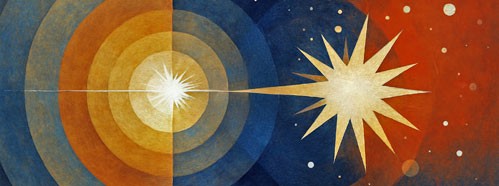
Illustration: Lorenzo Rumori
This PAS workshop celebrates the 100th anniversary of Georges Lemaitre’s 1927 seminal paper in which he demonstrated for the first time that the Universe is expanding. This paper, along with empirical discoveries by Edwin Hubble, began a revolution in our understanding of the cosmos and a century of discoveries: from the publication of Lemaitre's theory of the “Primeval Atom”, to the discovery of the cosmic microwave background – confirming the Big Bang – to the discovery of the accelerated expansion of the Universe and finally to the development of the standard cosmological model with only six independent parameters to explain the large scale structure of the Universe.
This is a good time to take stock of the state of modern cosmology. In spite of its successes, there are numerous open questions and challenges: the tension between high-redshift and local measurements of the expansion rate, the nature of dark matter and dark energy, and the choice of inflationary models, to name a few. Large telescopes equipped with increasingly sophisticated instruments are being used and planned to address these challenges. The workshop will present an overview the latest observational results from space missions and ground-based telescopes to map the cosmic microwave background, exploit weak lensing to map the geometry of the cosmos, use gravitational wave detectors and pulsar timing arrays to probe early universe processes, and search for the earliest supermassive black holes. Theoretical advances in quantum gravity, spacetime singularities and the possibility for new physics beyond the standard cosmological model will be discussed as well.
The workshop brings together experts to review the state of cosmology and deliberate its future course as well as celebrate the life and work of Georges Lemaître, who has guided the Pontifical Academy of Sciences as President from 1960 to 1966. By being both a visionary scientist and a priest, his legacy also encourages discussions on the
This PAS workshop celebrates the 100th anniversary of Georges Lemaitre’s 1927 seminal paper in which he demonstrated for the first time that the Universe is expanding. This paper, along with empirical discoveries by Edwin Hubble, began a revolution in our understanding of the cosmos and a century of discoveries: from the publication of Lemaitre's theory of the “Primeval Atom”, to the discovery of the cosmic microwave background – confirming the Big Bang – to the discovery of the accelerated expansion of the Universe and finally to the development of the standard cosmological model with only six independent parameters to explain the large scale structure of the Universe.
This is a good time to take stock of the state of modern cosmology. In spite of its successes, there are numerous open questions and challenges: the tension between high-redshift and local measurements of the expansion rate, the nature of dark matter and dark energy, and the choice of inflationary models, to name a few. Large telescopes equipped with increasingly sophisticated instruments are being used and planned to address these challenges. The workshop will present an overview the latest observational results from space missions and ground-based telescopes to map the cosmic microwave background, exploit weak lensing to map the geometry of the cosmos, use gravitational wave detectors and pulsar timing arrays to probe early universe processes, and search for the earliest supermassive black holes. Theoretical advances in quantum gravity, spacetime singularities and the possibility for new physics beyond the standard cosmological model will be discussed as well.
The workshop brings together experts to review the state of cosmology and deliberate its future course as well as celebrate the life and work of Georges Lemaître, who has guided the Pontifical Academy of Sciences as President from 1960 to 1966. By being both a visionary scientist and a priest, his legacy also encourages discussions on the relation between science, religion and philosophy.
The Pontifical Academy of Sciences regularly organizes workshops to discuss scientific knowledge and technological advances that affect human life.
The upcoming workshop will ...
The web site www.pas.va uses technical or similar cookies to make navigation easier and guarantee the use of the services. Furthermore, technical and analysis cookies from third parties may be used. If you want to know more click here. By closing this banner you consent to the use of cookies.