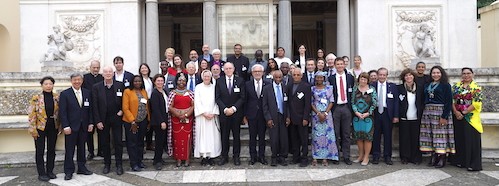
This conference gathered scientists, social scientists, Indigenous knowledge holders, educators, and youth from many regions of the world. Together we examined how braiding scientific and Indigenous knowledge can advance integral human development and societal transformation, especially through education for climate resilience. Our common reference point throughout the dialogue was the MAST framework – Mitigation, Adaptation, and Societal Transformation – as a holistic method for climate resilience.
1. Protecting the freedom required for braiding knowledge systems
Braiding scientific and Indigenous knowledge requires intellectual freedom, respect for diverse sources of wisdom, and protection of those who produce knowledge in different ways. These freedoms are increasingly under pressure around the world. As noted in our June statement, resilience requires resistance to these threats. Safeguarding scientific inquiry and Indigenous cultural expression is fundamental to any authentic partnership.
2. Conceptual clarity and shared understanding
Our discussions were guided by theory, philosophy, faith traditions, and conceptual clarity. We recognized the need for more precise definitions of local and Indigenous knowledge systems to improve dialogue and collaboration. The workshop surfaced many actionable pathways – grounded both in IK and contemporary sciences – that can serve people and planet in the Anthropocene.
3. Addressing structural inequalities between knowledge communities
Braiding traditions cannot succeed without acknowledging the deep asymmetries between scientific institutions and Indigenous communities. Humility is required from the scientific world, as is a concrete commitment to strengthening the capacities of Indigenous Peoples. This includes equitable access to the best scientific tools, laboratories, and research infrastructures – necessitating new, justice-oriented science policies.
4. The MAST framework as shared ground
The MAST concept provides a common
...
Read all
This conference gathered scientists, social scientists, Indigenous knowledge holders, educators, and youth from many regions of the world. Together we examined how braiding scientific and Indigenous knowledge can advance integral human development and societal transformation, especially through education for climate resilience. Our common reference point throughout the dialogue was the MAST framework – Mitigation, Adaptation, and Societal Transformation – as a holistic method for climate resilience.
1. Protecting the freedom required for braiding knowledge systems
Braiding scientific and Indigenous knowledge requires intellectual freedom, respect for diverse sources of wisdom, and protection of those who produce knowledge in different ways. These freedoms are increasingly under pressure around the world. As noted in our June statement, resilience requires resistance to these threats. Safeguarding scientific inquiry and Indigenous cultural expression is fundamental to any authentic partnership.
2. Conceptual clarity and shared understanding
Our discussions were guided by theory, philosophy, faith traditions, and conceptual clarity. We recognized the need for more precise definitions of local and Indigenous knowledge systems to improve dialogue and collaboration. The workshop surfaced many actionable pathways – grounded both in IK and contemporary sciences – that can serve people and planet in the Anthropocene.
3. Addressing structural inequalities between knowledge communities
Braiding traditions cannot succeed without acknowledging the deep asymmetries between scientific institutions and Indigenous communities. Humility is required from the scientific world, as is a concrete commitment to strengthening the capacities of Indigenous Peoples. This includes equitable access to the best scientific tools, laboratories, and research infrastructures – necessitating new, justice-oriented science policies.
4. The MAST framework as shared ground
The MAST concept provides a common framework for integrating IK and scientific expertise. Our deliberations emphasized that the world is currently underinvesting in mitigation, adaptation, and social transformation alike. Adaptation – particularly for the health, nutrition, and safety of the most vulnerable – remains severely underfunded. Investment in science and knowledge is also insufficient, and must rise substantially to meet the scale of crises.
5. Recognizing resilience without romanticizing suffering
While the scientific community greatly admires the resilience of Indigenous communities, it must never overlook the suffering that has often accompanied it. Local and regional climate summits should expand the inclusion of Indigenous leaders, ensuring that their perspectives shape solutions rather than simply inform them.
6. Youth as protagonists of transformation
Young people are not passive recipients of decisions made by older generations; they are already protagonists of societal transformation. Youth must be engaged as co-creators, not only learners. Education for climate resilience must therefore equip youth with three pillars of agency:
- scientific understanding of climate systems and solutions;
- ethical formation, rooted in solidarity and responsibility;
- community-rooted wisdom, including Indigenous knowledge systems that teach reciprocity with nature.
7. Higher education and emerging sciences
Advanced college and university education has a crucial role in exploring how emerging scientific breakthroughs – across disciplines – can contribute to braiding. The right to science includes the right of all peoples to benefit from new knowledge and technologies. Our institutions must take this responsibility more seriously.
8. Addressing emerging issues and opportunities across disciplines
The conference highlighted several cross-cutting areas in which IK and scientific knowledge can be braided for societal transformation:
(1) Societal Transformation
Ethical, scientific, religious, Indigenous, philosophical, and evolutionary perspectives offer complementary insights. Opportunities are emerging at the intersection of ancestral wisdom and artificial intelligence, which must be ethically guided and inclusive.
(2) Adaptation and Resilience
Braiding Indigenous and scientific knowledge can strengthen responses to habitat change, biodiversity loss, and resource pressures. Both knowledge systems contribute essential tools for local and regional resilience.
(3) Connecting Basic Science to the Issues of Braiding
Digitization of Indigenous languages will soon allow modern AI systems to learn from a greater diversity of linguistic and cultural traditions. This creates opportunities for preservation and empowerment – but also new risks of cultural extraction and exploitation. Ethical cooperation between scientists and Indigenous communities is imperative. Quantum sensing may complement Indigenous experiential knowledge, expanding capabilities in environmental and health monitoring.
(4) Earth Sciences, Food and Water Systems
Earth sciences increasingly rely on satellite data, open global datasets, climate models, and regional adaptation research. Indigenous Peoples must have full access to these resources – and representation in leadership roles within such programs. Food loss and waste can be reduced through scientific advances and behavioral transformation. Innovations in plant science and climate-adaptive agronomy must be accessible to all. Nature-based solutions need accelerated implementation.
(5) Health and Trauma
Climate-related stresses – including heat, floods, and deteriorating air quality – pose major health burdens. Neuroscience sheds light on the impacts of climate trauma, potentially extending across generations through epigenetics. Indigenous knowledge offers valuable insights into community-based healing and trauma resilience.
Closing Call: Educational Renewal for Our Common Home
Education emerged as a central theme across all sessions. We identified key priorities:
- Climate literacy for all, integrating both scientific and Indigenous knowledge.
- Teacher training that equips educators to teach climate resilience holistically.
- Student empowerment, enabling youth to speak, lead, and innovate in a time of crisis.
- Whole-curriculum transformation toward sustainability, systems thinking, and cultural understanding.
- Community-engaged learning, where students learn from local ecosystems, Indigenous traditions, and lived experiences.
- Intergenerational learning, connecting elders, scientists, teachers, and youth as co-educators.
These educational pathways form the backbone of societal transformation.
We call for an Educational Renewal that draws upon all sources of human knowledge – scientific, Indigenous, philosophical, ethical, and spiritual. This renewal should shape curricula at all levels, from primary school to university, and empower learners to become agents of climate resilience and social transformation.
The Jubilee of Knowledge renews our shared commitment to weave together: faith and reason, tradition and innovation, youth and experience, Indigenous knowledge and scientific discovery – all in service of people and planet, and for the flourishing of present and future generations in our common home.
List of participants
Prof. Sr. Helen Alford
President
The Pontifical Academy of Social Sciences
United Kingdom |
Prof. Edward De Robertis
Distinguished Research Professor
University of California, Los Angeles
PAS Academician
United States of America |
Prof. Dr. Joachim Von Braun
President
The Pontifical Academy of Sciences
Germany
|
Dr. Josep Garì
Head of Climate, Forests and Land
UNDP
Switzerland |
H.E. Cardinal Peter K.A. Turkson
Chancellor
The Pontifical Academies of Sciences and Social Sciences
Vatican City
|
Ms. Jennifer Gross
Founder & President
Blue Chip Foundation
United States of America |
Msgr. Dario E. Viganò
Vice Chancellor
The Pontifical Academies of Sciences and Social Sciences
Vatican City
|
Ms. Ananya Gupta
High School Student
University of California Los Angeles (UCLA)
United States of America |
Prof. Vanderlei S. Bagnato
Professor
USP-Brazil/TAMU-USA
PAS Academician
Brazil
|
Prof. Mohamed Hassan
President
Sudanese National Academy of Sciences
PAS Academician
Sudan |
Prof. Gustavo Beliz
Technological Innovation
Law, Economic and Social Development, Technology and Innovation
PASS Academician
Argentina
|
Mr. Ludolphe Hessou
Student
Collège Paul-Verlaine
Malzéville
France |
Ms. Audrey Borr
Trainer, Project Coordinator
University of Lorraine / House for Science (France)
Luxembourg
|
Archbp. Dr. Antje Jackelén
Archbishop emerita / Senior Advisor
Church of Sweden / Lund University
Sweden |
Prof. Chien-Jen Chen
Distinguished Professor
PAS Academician
Taiwan
|
Mr. Sanjib Kumar Chaudhary
Author
Global Voices
Nepal |
Prof. Christina Christie
Wasserman Dean of the School of Education and Information Studies at UCLA
United States of America
|
Dr. Georgia Ann Lazo
Associate Dean UCLA Partnership Schools
University of California Los Angeles UCLA
United States of America |
Dr. Agnes Leina
Executive Director
Il`laramatak Community Concerns
Kenya
|
Prof. Carola Suárez-Orozco
Professor in Residence
Harvard Graduate School of Education
United States of America |
Prof. Pierre Léna
Professor Emeritus
Observatoire et Université de Paris
PAS Academician
France |
Dr. Marcelo Suárez-Orozco
Chancellor
University of Massachusetts Boston
PASS Academician
United States of America |
Mr. Jose Manuel Sauna Mamatacan
Lider en el proceso de comunicación de saberes ancestrales
Mexico |
Amb. Hindou Oumarou Ibrahim
President
AFPAT
United States of America |
Dr. Ora Marek-Martinez
Associate Vice-President/ CO-Principal Investigator
Northern Arizona University/ Center for Braiding Indigenous Knowledges and Science
United States of America
|
Fr. Michał Paluch OP
Full Professor
Pontifical University of St. Thomas Aquinas “Angelicum”
Italy |
Prof. Michela Massimi
Professor of Philosophy of Science
University of Edinburgh
United Kingdom
|
Prof. Ulrich Pöschl
Director
Max Planck Institute for Chemistry
Germany |
Dr. Juergen Mittelstrass
Professor
University of Konstanz
PAS Academician
Germany
|
Prof. Veerabhadran Ramanathan
Distinguished Research Professor
University of California at San Diego
PAS Academician
United States of America |
Ms. Victoria Moebus
Professor
Geffen Academy at UCLA
United States of America
|
Mr. Carlos Emiliano Bautista Reyes
Geffen Academy at UCLA
High School Student
United States of America |
Mr. Calisto Ochieng
Manager, Strategic Partnerships and Fundraising
World Organization of the Scout Movement
Kenya
|
Mr. Stanley Kimaren Ole Riamit
Executive Director
Indigenous Livelihoods Enhancement Partners (ILEPA)
Kenya |
Ms. Noelani Ogasawara
Professor
School of Education and Information Studies at UCLA
United States of America
|
Ms. Nithya Ramanathan
Witness
United States of America |
Prof. Claudia Robles
Director
Innovation in Science Education (INNOVEC)
Mexico
|
Prof. Fr. Aldo Skoda
Director
Scalabrini International Migration Institute
Italy |
Dr. Maria Dolores Sánchez Galera
Senior Research Advisor
Dicastery for Integral Human Development
Vatican City
|
Prof. Ester Innocent Tissian
Associate Research Professor
Institute of Traditional Medicine
Muhimbili University of Health and Allied Sciences
Tanzania |
Prof. Hans Joachim Schellnhuber
Director General
International Institute for Applied Systems
Analysis (IIASA)
PAS Academician
Austria
|
Prof. Cecilia Tortajada
Professor
University of Glasgow
PAS Academician
United Kingdom |
Dr. Vian Sharif
Founder & President
Nature Alpha
United Kingdom
|
Prof. Octaviana Valenzuela Trujillo
Professor Emeritus
Northern Arizona University
United States of America |
Prof. Wolf Singer
Distinguished Physiology Professor and Researcher
PAS Academician
Germany |
Prof. Ewine van Dishoeck
Professor and Researcher
Leiden University
PAS Academician
The Netherlands |
Read Less